Salvador Dali was born in May, 1904, in Figueras, Spain, in the foothills of the Pyrenees Mountains. His artistic talent showed at a young age, and he started his first drawing lessons when he was ten years old. He began to study art at the Royal Academy of Art in 1923, but he was expelled twice and never took the final examination because he believed that he was more qualified than those who would have examined him. A humble person, Dali was not.
In 1928, Dali went to Paris, where he became a leader of the Surrealist Movement. With the Cubism and Surrealism art movements among the most progressive of the day, Dali created some of his most famous works, including “The Persistence of Memory,” an icon of the Surrealist movement. During this time, he met his future spouse, Helena Diakanoff Devulina, better known as Gala. Gala was a Russian immigrant who was married to poet Paul Eluard when Dali met her. She became his companion, his muse, his model, and his business manager. Throughout his life, Dali was a master of self-promotion and a genius at parlaying his artistry into financial success.
To evade War II, Dali chose the US as his permanent residence in 1940. Dali was moving into a new type of painting with a preoccupation with science and religion. As he moved away from Surrealism, and into his classical period, he began his series of 19 large canvases, many concerning scientific, historical, or religious themes. Among the best known of these works are The Hallucinogenic Toreador and The Discovery of America by Christopher Columbus. He was also inspired by the great classical masters like Raphael, Velasquez, and Ingres.
In 1948, Dali and Gala returned to Europe and spent their time in Spain, Paris, or New York. Dali painted one monumental history painting every year during the summer months in Lligat, Spain. In 1974, Dali opened the Dali Museum-Theater in Figueras, Spain. After Gala’s death in 1982, Dali’s health began to fail, and he had to retire due to palsy, a motor disorder. His hands trembled and were weak, and he could no longer hold a brush. Towards the end of his life, Dali lived in the tower of his own museum, where he died in 1989 from heart failure. Outside of the Dali Theater-Museum created by Dalí himself in his home town of Figueras, Catalonia, Spain, St. Petersburg's Dalí museum has the world's largest collection of Dalí's works.
From his early impressionist paintings through his transitional surrealist works and into his classical period, Dali was a constantly growing and evolving artist. He worked in all media, including oils, watercolors, drawing, graphics, sculptures, films, photographs, performance pieces, and jewels. He was known for his cutting-edge artwork and his flamboyant personality. Dali’s art may not be your cup of tea. It isn’t mine, but I nevertheless marvel at his creativity and the breadth of his achievements. His work is on display in many museums and remains eminently collectible.

Albert Whitted Airport
The Albert Whitted Airport is owned and operated by the City of St. Petersburg. It provides convenient access by air to the city's downtown waterfront, business district and urban communities

Galbraith Terminal, named in honor of local philanthropists, John and Rosemary Galbraith, who have supported both the community and the airport.

The Hangar Restaurant
In the words of a local food critic, “Good food makes for a smooth landing at the Hangar Restaurant at Albert Whitted Airport in St. Petersburg.”

The airfield occupies 110 acres and handles around 80,000 general aviation aircraft operations annually.

A view of 3 planes from the restaurant

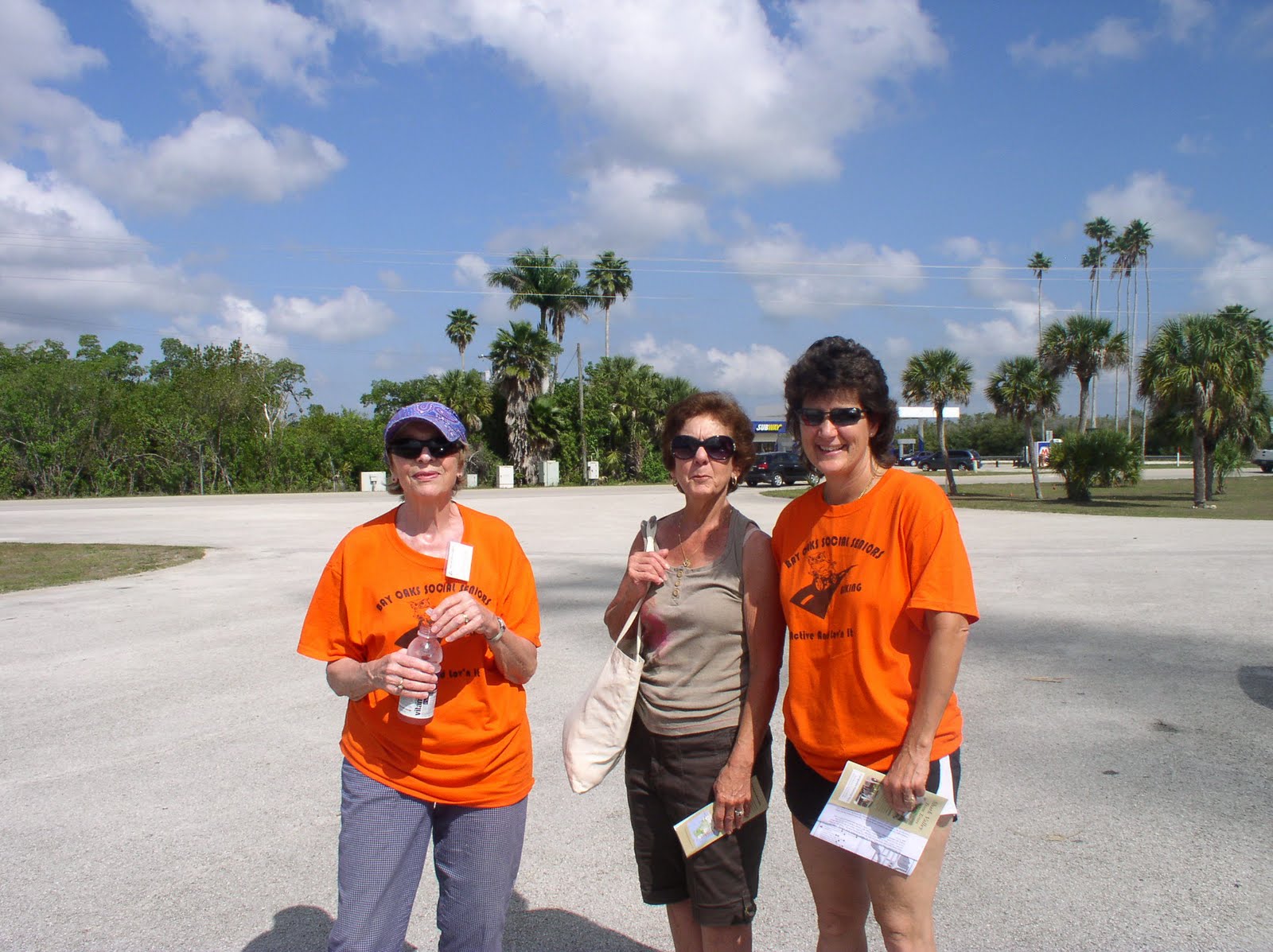
Bay Oaks Social Seniors Marchyne, Jean, Margie, Cora, Emma, Joanne, Sara and Justin (youngsters who lead the group), Robert, Barbara, Mary, Shirley, and John

Marchyne, Jean, Margie, Cora, Emma, Joanne, Sara, and Justin

Robert, Barbara, Mary, Shirley, and John

Marchyne, Jean, Margie, Cora, Emma, Joanne, Sara, and Justin

Robert, Barbara, Mary, Shirley, and John

Justin, Becky, Robert & Barbara

Museum Entrance and Salvador Dali's signature as seen on the outside of the museum
The thirty-five million dollar Dali Museum was built on the downtown waterfront next to the Mahaffey Theater, featuring a large glass entryway and skylight. The new museum opened on 1-11- 11 at 11:11 am. (I couldn’t find any significance in Dali’s life to explain the date and time. I think it was done that way just because they could.)

Mary & Barbara at the entrance to the Dali Museum

Emma, Jean, Joanne & Margie about to enter the museum

A living wall of plants at the entrance to the museum

Becky in front of the wall of plants and beside the “fountain of youth.”

A grotto-like massive stone with a vertical garden seems to hold up a corner of the building.

The Mahaffey Theater is a 2000-seat performing arts venue adjacent to the waterfront of Tampa Bay and across the plaza from the Salvador Dali Museum.

A Dali-inspired bench behind the museum

The glass dome rises 75 feet from the plaza.

The window wall undulates around the building.

The window wall as seen from the inside on the ground floor

This is how the window wall looks from the inside on the 2nd Floor. The second floor houses administrative offices and a research library.

This is the view of the window wall/atrium on the top floor.
The main galleries are on the third floor atop a spiral staircase which some say resembles a strand of DNA. The artwork on the third floor is located above the flood plain and will be protected through a Category 5 hurricane storm surge. Its 18- inch-thick concrete walls can withstand 165 mph winds. The danger of a hurricane is a very real threat in this area of the country.

A view of Tampa Bay from inside the museum

Sliding Doors Entrance
The doors open like an elevator and lead to the sizable gift shop.
The doors open like an elevator and lead to the sizable gift shop.

Poster of Museum Opening
The museum's collection includes 96 oil paintings, over 100 watercolors and drawings, 1,300 graphics, photographs, sculptures and objets d'art, and an extensive archival library, and displays are periodically rotated.
The museum's collection includes 96 oil paintings, over 100 watercolors and drawings, 1,300 graphics, photographs, sculptures and objets d'art, and an extensive archival library, and displays are periodically rotated.

The BOSS group is waiting for the tour to begin.

Gift Shop Wall of Posters
This gift shop is not your typical museum gift shop. It is very large and jam-packed with all things Dali. You have to enter the museum through the gift shop and wend your way through the aisles and aisles of items to get to the ticket sales booth. Also located on the ground floor is a snack bar, theater, and community room.
This gift shop is not your typical museum gift shop. It is very large and jam-packed with all things Dali. You have to enter the museum through the gift shop and wend your way through the aisles and aisles of items to get to the ticket sales booth. Also located on the ground floor is a snack bar, theater, and community room.

A glitzy, giant-sized praying mantis is suspended from the ceiling of the gift shop. This innocent- looking praying mantis had a sinister symbolism to surrealists because the female praying mantis devours the male after mating with him.

The Disintegration of Persistent Memory.
This work was done from 1952 to 1954. Dalí employed extensive symbolism in his work. The hallmark "soft watches" that first appear in The Persistence of Memory suggest Einstein's theory that time is relative and not fixed. The idea for clocks functioning symbolically in this way came to Dalí when he was staring at a runny piece of Camembert cheese on a hot day in August. Dali created this painting to explore the effects of nuclear weaponry, asserting that the invention of such weaponry had a profound effect upon everyone on the planet, even those in the small fishing villages along the coastline of Spain. (This is a photo of the Dali poster and does not do the artwork justice, but I hope it gives you the idea.)

The Ship & The Discovery of America by Christopher Columbus
The Discovery of America was painted in 1958 and 1959. It is a Masterwork, which is more than 14 feet tall. The center of the painting is dominated by a young Columbus who is leading one of his ships onto the shoreline of the New World. He holds in his right hand a standard on which the face of Gala is depicted in the pose of St. Helena, the mother of Constantine. To the right of Columbus is a kneeling figure of a monk, who is actually Dali.

The Hallucinogenic Toreador
This large vertical composition was begun in Port Lligat in 1968 and finished in 1970. This is a double image painting that repeats the image of Venus de Milo in such a way that the shadows form the features of the toreador. The Dali museum is home to 7 of the 18 masterwork paintings by Dalí (including The Hallucinogenic Toreador and the Discovery of America by Christopher Columbus), the most of any museum in the world. To be considered a masterwork, these paintings must be at least 5 feet in any direction and have been worked on for over a year.

Completed in 1976, this painting is approximately 6 ¼ feet x 8 ¼ feet. Unlike most artists, Dali liked naming his works using very long names rather than just brief descriptions. As the painting’s title suggests, when you look at this painting from a distance, it becomes a portrait of Abraham Lincoln.


Rolls Royce Sign.

Side view of the Rolls
Notice the details, including the snails and seaweed all over the car. I love the whimsicality of this piece, and the longer you look, the more you discover the unexpected, like the deep-sea diver-chauffeur and his passenger, the mermaid.

Rolls Diver/chauffeur in diving gear

Mermaid Passenger
Sorry I couldn’t get a better pic of the mermaid inside because of all the reflections. But, again, I hope you get the idea.


Sorry I couldn’t get a better pic of the mermaid inside because of all the reflections. But, again, I hope you get the idea.

Rear view of the Rolls, complete with manta ray on the roof

It's time to leave the museum and be on our way back home. Emma is ready.

The final view of the Dali Museum as we head for home. Farewell to the museum honoring the most famous surrealist artist/showman of the 20th century.