Thursday, May 14, 2015

Naples Botanical Garden - Unearthed: Dinosaurs in the Garden


The normally serene and peaceful Naples Botanical Garden has been taken over by life-sized animatronic (animated by electronics) dinosaurs that move, snarl, roar, open their jaws, blink their eyes, move their arms and one that even spits water at people. The dino designers have done their research, too, getting tips on movement, sound, skin texture and more from world-renowned dino experts. The ten dinosaurs have steel skeletons and a realistic, urethane-compound skin. Each dinosaur has its own power source and a computer “brain” that controls its movements. Some are located in the Brazilian Garden, but the Florida Garden, with its open, grassy space seems a more natural location for the dinos. The exhibition’s dinosaurs span the Mesozoic era, with species from the Triassic, Jurassic and Cretaceous periods. In addition to the dinos, the garden strategically placed and planted era-appropriate plants like cycads and ferns with Triassic species, and flowering plants with Cretaceous period species.


This entrance to the Event Plaza faces the parking lot.


Bay Oaks Social Seniors, Becky, Richard, Marilyn, Martha, Carmen, Marlene, Pauline and Carol in front of the newly-opened Eleanor and Nicholas Chabraja Visitor Center.


Welcome to “Gardens with Latitude,” latitude meaning the same geographical band and also freedom of choice to enjoy the garden in different ways.

 
Dinosaurs Exhibit Sign
The exhibit dates are March 14 through July 5, and it is open from 9:00AM to 5:00 PM.
 
 
The new entrance to the Naples Botanical Garden leads visitors from a shaded pavilion on an elevated walkway past 2 gardens, Kathryn’s Garden, and Irma’s Garden. Kathryn’s Garden includes a palm-fringed jungle stream and lush tropical foliage.

 
The meandering watercourse unites the 2 gardens, one with a “jungle” atmosphere and the other with an emphasis on unique plants. Both gardens are bordered by walkways, making them visible from all sides.

 
The most appealing aspect of the new entrance is that visitors immediately enter a jungle landscape, surrounded by gardens before they are officially IN the garden. The fountain in the background is a primeval-looking rectangular fountain, made from Florida’s oolitic (oolitic = made up of small, egg-shaped particles) limestone.

 
A tropical water lily in the pool
 
 
The Butterfly House in the Children’s Garden has colorful local butterflies and the native plants that can attract them into your garden.


The Zebra Longwing (middle of the photo) is the official state of Florida butterfly.
 

Richard and Marilyn, sitting on, what else?-- a butterfly bench.


A lot of Buckeye chrysalises in the Chrysalis House and one newly-hatched Buckeye butterfly

 
A Garden Guide shows us a leaf on which a butterfly has laid eggs.
 
 
The unusual flowers of a Dutchman’s Pipe vine, host plant for the pipe vine swallowtail butterfly

 
Carmen in the Children’s Garden in front of a child-sized cottage
 
 
A mosaic-decorated tub of succulent plants in the Children’s Garden
 
 
The first dinosaur that Carol, Carmen, Marlene and Pauline saw was the Brachiosaurus.
 
 
The brachiosaurus’s long neck and head rise 18 feet into the air, and its body stretches 85 feet long.

 
The head of the brachiosaurus high among the tree branches
It was plant-eating and well-suited to be a “high browser”
 
 
Brachiosaurus Information Sign

 
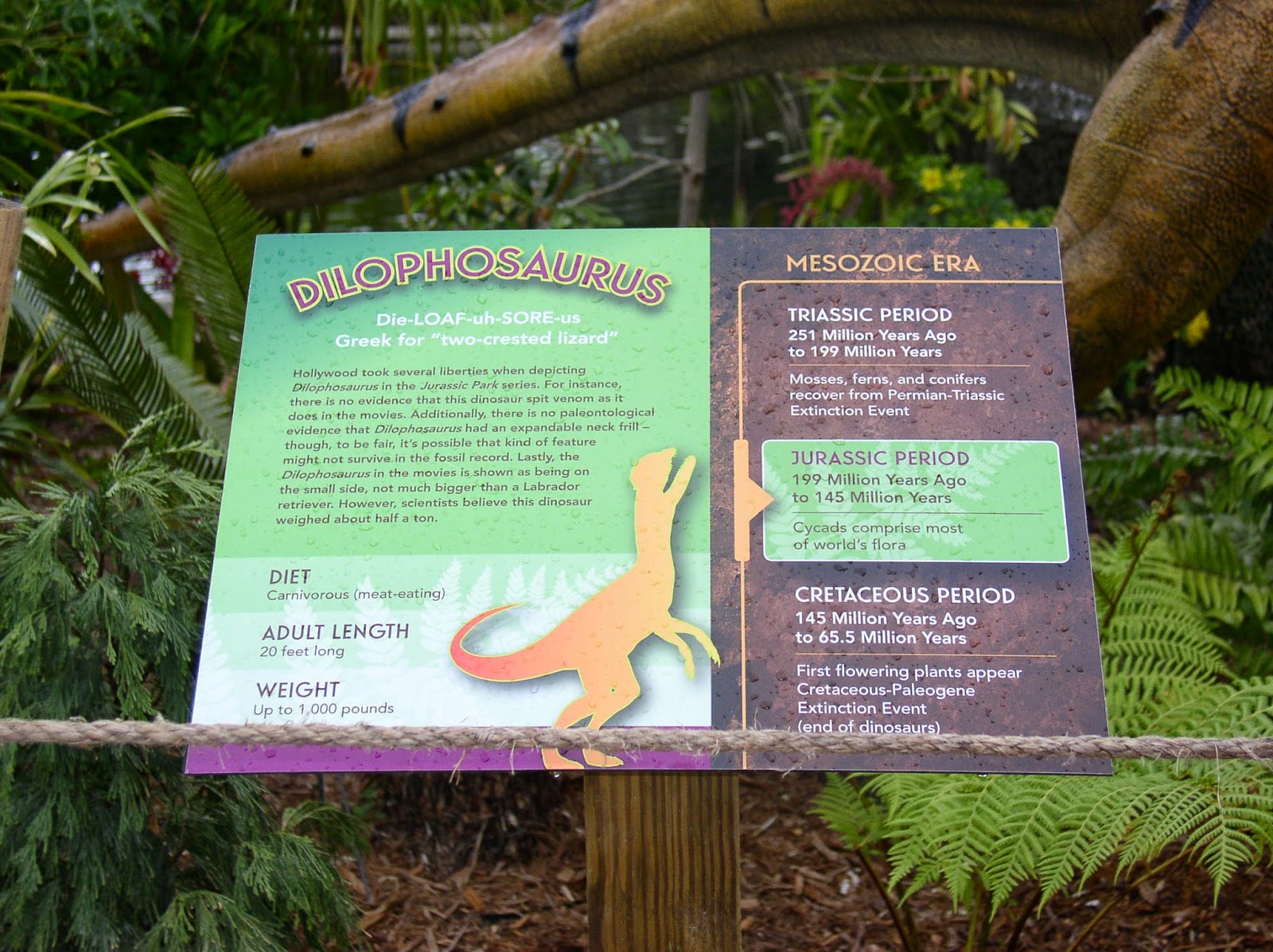
A Dilophosaurus mother, a Jurassic period predator, is notable for having a pair of rounded crests on its skull.


Martha in front of the Dilophosaurus


This is the baby Dilophosaurus. Even though there was no evidence that these animals spit poison, this one sprays water on unsuspecting passersby.

 
Dilophosaurus Information Sign
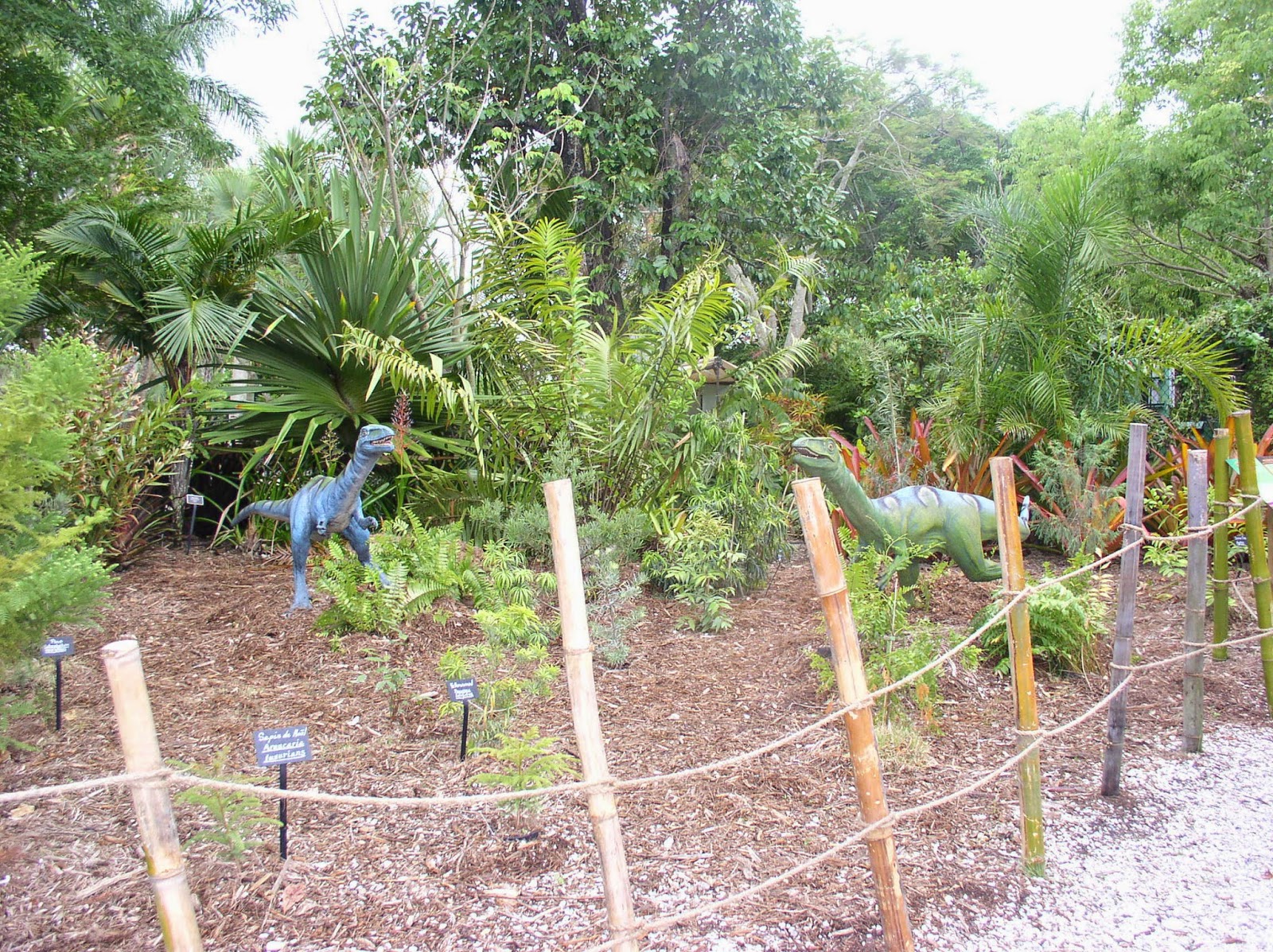
 

The Triassic period star, the Coelophysis, is a primitive bipedal carnivorous dinosaur that may have hunted in packs. The plants that lived in this timeframe were cycads, ferns, and non-flowering plants.


One Coelophysis, a small (by dinosaur standards), slenderly-built, fast and agile runner


The other Coelophysis in the exhibit


Coelophysis Information Sign


The LaGrippe Orchid Garden will rotate hundreds of species of orchids and feature some of the world’s smallest and largest varieties. Oftentimes, orchid exhibits at botanical gardens are in a hothouse environment. These orchids are displayed in an open-air, more naturalistic way. 


 The floor is paved with Florida coral rock. Huge oolitic (made up of small, egg-shaped particles) limestone boulders are planted with orchids and other epiphytes.


Medinilla, sometimes called “Malaysian Orchid”
 

Cattleya Orchids


Another rectangular limestone fountain continues the theme from Kathryn’s and Irma’s Gardens and also provides the cooling sound of moving water.


In the Brazilian Garden, a bloom on a water chestnut tree, commonly called the “Money Tree,” supposedly because it will bring prosperity to your home.


In planning the Naples Botanical Garden, it was decided that the Garden should reflect the plants of areas that are the same latitude as Naples. Brazil is one of these areas, so building the Brazilian Garden was a logical decision. In addition, Brazil is the homeland of Roberto Burle Marx, widely considered to be the father of modern landscape architecture.
 

The plaza is atop an infinity pool from which waterfalls cascade into a lake.


The centerpiece of the Brazilian Plaza is an original Burle Marx ceramic mural, a massive 7-by-18-foot piece. The Garden Guide is speaking with our group about the Brazilian Garden.


A tropical water lily in the infinity pool of the Brazilian Plaza.
The water looks black because it is dyed black, with a natural vegetable dye.


A Wisteria promenade leads visitors to the Florida Garden, where the rest of the dinosaurs are located.


The Edmontonia dinosaur was bulky, broad and tank-like.


Edmontonia Information Sign
  
 
“Tyrannosaurus” is ancient Greek for “tyrant lizard.” It is the true star of the exhibition.
 
 
The 40-foot life-sized Tyrannosaurus Rex might well have pursued the well-armored Edmontonia, some 75 million years ago.


Was the T-Rex a predator or scavenger? Probably a bit of both, but unquestionably, it could exert one of the largest bite forces among all terrestrial animals


T-Rex Information Sign
 
 
The Styracosaurus may look menacing, with its six-spiked frill and a two-foot-long nose horn, but looks can be deceiving. It is herbivorous.


It is speculated that the fearsome appearance of the Styracosaurus was needed to fend off enemies, or that bigger frills and sharper spikes may have attracted more females of the species.

 
Styracosaurus Information Sign
 
 
The Parasaurolophus was a herbivore whose family of dinosaurs was known for its bizarre head adornments.

The regulation of body heat is one of the more functional explanations of the crest.


Parasaurolophus Information Sign


The Stegosaurus may have been bus-sized, but its array of scales and tail spikes both had defensive uses.

 
Stegosaurus Information Sign
 
 
Stage 62 Deli in the Mercato in Naples
 
 
BOSS members, with Bay Oaks staff member, Jackie, awaiting lunch in Stage 62 Deli


Friday, April 17, 2015

Gods and Heroes: Masterpieces from the École des Beaux-Arts, Paris

Bay Oaks Social Seniors visit the Baker Museum in Naples, Florida,

 on April 16, 2015


The École des Beaux-Arts was founded during the reign of Louis XIV, the Sun King, to teach painting, sculpture and, most importantly, drawing to young artists. The school was government-run and highly competitive. At the École, learning how to construct paintings or sculpture of the idealized human form with carefully delineated anatomy, expressive faces, and realistic landscape settings was understood by aspiring artists to be essential to success. 

In this exhibit, there were approximately 140 paintings, sculptures and drawings from the Ecole des Beaux Arts, dating from the 17th through 19th centuries. The works focused on such themes as courage, sacrifice and death, as did the epic deeds of gods and heroes recounted in the Bible and the works of Homer, from which artists drew their inspiration. The works of art were arranged according to themes: one wall featured the yearly winners of the male torso competition; another area had sculptures and paintings depicting specific emotions; still another area had a landscape competition, and one room was devoted to Grand Prix winners.  This arrangement made the exhibit feel like an integrated whole rather than a collection of disparate works of art.


One of Ernest Trova’s gleaming humanoid sculptures is in front of Artis-Naples,

formerly Naples Philharmonic.
 
 
Six almost life-size figures radiate from a cube. They are armless and featureless.
The sculpture is a later rendition of Trova's Falling Man series.
 
 
Gateway to the Arts, 1993 by Yaacov Agam
The sculpture was a gift from the Kahala Hilton Hotel, where the sculpture was first installed,
and the hotel owner, William Weinberg.


Paul, Pauline, Marlene, Britta, Joann, Martha, Carmen and Dan at the entry to the Baker Museum of Artis-Naples. The entrance gate sculpture is by metal artist Albert Paley.


The entry gates are 16 feet tall by 10 feet wide, although only the bottom half swing open to admit visitors into the courtyard. The Figge Conservatory is behind the group.


Posters of the main exhibits currently at the Baker Museum: Apollo and Diana Killing the Children of Niobe, 1772, by Pierre-Charles Jombert (Niobe had boasted to the gods about how many children she had, so the gods retaliated by killing them); and The Great Table, 1965, by Rene Magritte There is a giant, petrified apple in the picture. Your interpretation of this painting is as good as anyone's.


Pauline, Carmen and Marlene in front of the “Surrealism in Belgium” exhibit poster.
 
 
Martha and Pauline in front of the “Gods and Heroes” exhibit poster
 
 
A poster of the famous painting, Erasistratus Discovers the Cause of Antiochus's Disease, 1774, by Jacques-Louis David (1748-1825) (The cause of his disease was the young man’s lovesickness for his stepmother.) The painting won the 1774 Prix de Rome. The winner of this prize stayed in Rome, at government expense, studying art for 3-5 years.


The courtyard just past the entrance to the museum
 
 
This figure sits atop a column in the courtyard of the Baker Museum.
The sculptor is Hanneke Beaumont, a Dutch-born sculptor. The name of the sculpture is L’ennui or “Boredom.”
 
 
Dan, Joann and Britta
 
 
Dan examining Four Squares Excentric, 1989, by George Rickey (1907-2002)
The squares can all rotate simultaneously--almost makes you dizzy to watch.


A parking lot sculpture

 
Dale Chihuly sculpture, Blue Icicle, in the lobby of the museum
 
 
Sorry, no photos allowed in the exhibit
 
 
The domed glass and steel structure of the Figge Conservatory
In the Conservatory, mesh figures are suspended in mid-air, but they are hard to see in the bright sunlight.
 
 
Figge Conservatory

 
Marlene, Martha, Pauline and Paul in Brio Tuscan Grille at Waterside Shops in Naples

 
Britta, Joann, Dan and Carmen across the table

 
The waitress serves Paul a birthday cheesecake, complete with candles.


Paul digs into the cake.

Notice all the spoons--what else could Paul do, but share his cake with everyone at the table?
And that’s exactly what he did, to everyone's eating pleasure.